Saturday, February 21, 2026

Artwork of the Day
Where the reef dissolves, the stars begin —
tendrils of light in teal and violet spin,
each polyp a planet, each current a prayer,
the ocean exhales into luminous air,
and what was depth becomes the infinite within.
Faces of Grit

Junko Tabei
The woman who climbed above a world that told her to stay down
Keep Android Open: F-Droid Sounds the Alarm on Google's Lockdown
F-Droid published a rallying cry warning that Android's openness is under sustained assault from Google's tightening restrictions. The post details how Play Integrity API, restrictive sideloading warnings, and new permissions barriers are systematically closing off what was once the most open major mobile platform. With over 1,100 upvotes on Hacker News and 447 comments, the developer community responded with alarm. The concern is not just about F-Droid's survival but about the broader principle — that a platform built on open-source foundations is being quietly turned into a walled garden rivaling Apple's iOS.
Facebook Is Cooked: A Developer's Deep Dive into Platform Decay
A detailed technical analysis of Facebook's platform degradation went viral with nearly 800 upvotes and over 460 comments. The post dissects how Facebook's core product has become a feed of AI-generated engagement bait, recycled content, and aggressive monetization that has driven away its original user base. The discussion turned into a broader examination of how social platforms follow a predictable lifecycle — growth, monetization pressure, quality collapse, and eventual abandonment by the users who made the platform valuable in the first place.
Phil Spencer Steps Down After 38 Years at Microsoft
Microsoft's gaming chief Phil Spencer announced his retirement after 12 years leading Xbox and 38 years at the company. In a surprise move, Asha Sharma from Microsoft's CoreAI division will replace him, while Xbox President Sarah Bond is also departing. The leadership shake-up signals Microsoft's intent to merge its gaming and AI strategies under a single vision. Matt Booty has been promoted to Executive Vice President and Chief Content Officer to ensure continuity on the content side.
GGML Joins Hugging Face to Secure the Future of Local AI
The team behind llama.cpp and the GGML tensor library announced they are joining Hugging Face, the leading open-source AI platform. The move is framed as ensuring the long-term sustainability and progress of local AI — running models on consumer hardware without cloud dependencies. With 677 upvotes on HN and heated discussion, the community is cautiously optimistic but watchful. The acquisition preserves the open-source nature of the project while giving the team resources to keep pace with rapidly growing model sizes.
Anthropic Launches Claude Code Security in Research Preview
Anthropic released Claude Code Security, a new feature designed to detect and prevent security vulnerabilities in AI-assisted code generation. The tool scans code produced by Claude for common attack vectors including injection flaws, authentication bypasses, and data exposure risks. The r/ClaudeCode community received it with cautious enthusiasm — the consensus is that security tooling baked directly into coding assistants is overdue, but the real test will be whether it catches the subtle, context-dependent vulnerabilities that automated scanners traditionally miss.
Wikipedia Deprecates Archive.today Over DDoS and Content Manipulation
Wikipedia has begun removing links to Archive.today after evidence emerged that the archiving service conducted DDoS attacks against blogs and altered web captures. The decision affects thousands of citations across the encyclopedia. With 325 upvotes and 185 comments on HN, the discussion highlighted the fragility of web preservation when a trusted archival service turns adversarial. The broader concern is what happens when tools the internet relies on for historical accuracy become unreliable.
Artemis II Fueling Test Succeeds, March 6 Moon Launch in Sight
NASA reported no significant leaks during a second fueling test of the Space Launch System rocket at Kennedy Space Center, clearing a major hurdle for the Artemis II crewed lunar flyby mission. After hydrogen leaks forced seal replacements following the first test on February 2, technicians swapped components at the launch pad. NASA is now targeting March 6 as the earliest launch attempt, which would send four astronauts around the Moon for the first time since Apollo 17 in 1972.
Andrej Karpathy Defines 'Claws' as the New AI Agent Layer
Simon Willison highlighted an Andrej Karpathy essay coining 'Claws' as the emerging term for OpenClaw-style agent systems — AI agents running on personal hardware, communicating via messaging protocols, acting on instructions and scheduling autonomous tasks. Karpathy described them as a new orchestration layer on top of LLM agents, handling persistence, scheduling, context management, and tool coordination. He noted the ecosystem is fragmenting rapidly with NanoClaw, ZeroClaw, IronClaw, and PicoClaw all jockeying for position. Willison observed that Karpathy has an ear for naming trends (he coined 'vibe coding') and this terminology is likely to stick. The piece signals that personal AI agents are crossing from hobbyist projects into a recognized infrastructure category.
Microsoft's Blueprint for Proving What's Real Online
Microsoft's AI safety research team published a blueprint for digital content authentication, evaluating how current provenance methods fare against interactive deepfakes and hyperrealistic generation models. The framework recommends technical standards for AI companies and social media platforms to adopt, focusing on cryptographic signing of original content, metadata chains of custody, and platform-level verification displays. MIT Technology Review notes that while the technical standards are sound, adoption depends on platforms voluntarily implementing them — and the biggest generators of AI content have the least incentive to make their output easily identifiable.
AI Agents Can Now Exploit Most Smart Contract Vulnerabilities Autonomously
OpenAI and crypto firm Paradigm built EVMbench, a benchmark measuring how well AI agents find, fix, and exploit Ethereum smart contract vulnerabilities across 120 real-world flaws from 40 security audits. GPT-5.3-Codex exploited 72 percent of vulnerabilities autonomously, while Claude Opus 4.6 led in detection at 45.6 percent. When given hints about vulnerability locations, exploit success rates jumped from 63 to 96 percent. With over $100 billion locked in smart contracts, the research highlights a dual reality: AI could dramatically improve smart contract security auditing, but the same capabilities in adversarial hands represent a serious and growing threat to decentralized finance.
I have built automations for a dozen startups this year. Here is what nobody tells you.
An experienced automation builder shares hard-won lessons from building real, paid automations for startups. The first insight: most founders have no idea what to automate — they say 'automate my business' the way someone tells a mechanic 'fix my car.' The real value is spending the first week just watching them work and finding the one repetitive task silently eating three hours of their day. Second, n8n is powerful until you chain more than 15 nodes together, at which point you are building a debugging nightmare. The post argues that the highest-value automation skill is not technical — it is the ability to identify which 20 percent of manual work produces 80 percent of the operational drag.
The observation about founders not knowing what to automate resonates deeply. The discovery phase is where 90 percent of the value lives.
— Alert_Journalist_52540 pts
n8n's 15-node limit is real. After that threshold, you need to split into sub-workflows or you will lose your mind debugging.
— Empty-Class-118317 pts
I want to learn agentic AI
A React developer with 10 years of experience and a 1.5-year career gap asks the community for guidance on pivoting into agentic AI. The thread becomes a practical roadmap discussion. Top responses recommend starting with LangGraph or CrewAI for structured agent frameworks, building small projects that solve real problems rather than following tutorial paths, and combining existing React skills with AI agent frontends as a competitive differentiator. Several commenters note that the 'agentic AI' job market is still forming and that demonstrating practical builds matters more than certifications.
Build something real. Tutorials teach you the API, but building something that handles edge cases teaches you the architecture.
— usrname--23 pts
Your React background is an asset. Most AI agent devs can build backends but struggle with UIs. Combine both and you stand out.
— Soft_Temptressss15 pts
How you guys made AI agents?
A developer shares their setup — Claude Code for coding agents, OpenClaw for orchestration — and asks what others actually use in practice. The thread reveals a fragmented ecosystem: LangGraph for complex stateful workflows, CrewAI for multi-agent coordination, n8n for no-code automation, and plain Python scripts with direct API calls for developers who want full control. The consensus is that no single framework dominates, and the choice depends heavily on whether you prioritize speed of prototyping, production reliability, or debugging transparency.
For production, plain Python with direct API calls. Frameworks add abstraction layers that become debugging nightmares when things go wrong.
— Kakashi2011199976 pts
LangGraph for anything stateful, CrewAI for multi-agent, n8n for non-technical stakeholders. There is no one tool to rule them all.
— crookedantler5 pts

Introducing Claude Code Security, now in limited research preview
Anthropic announced Claude Code Security, a dedicated security scanning layer built directly into Claude Code. The feature analyzes generated code for vulnerabilities including SQL injection, authentication flaws, and data exposure patterns before it reaches production. The community response was positive but measured — the top comment notes that baked-in security is long overdue, while skeptics question whether it can catch the subtle, context-dependent vulnerabilities that existing SAST tools already miss. The real test will be adversarial edge cases where the model's own code patterns create novel attack surfaces.
Finally. The amount of insecure code being shipped through AI assistants without any security review was becoming a serious industry problem.
— DictatorDoge25 pts
Hope this goes beyond basic OWASP top 10 checks. The real value would be catching logic-level vulnerabilities that scanners miss.
— Lieffe23 pts
This needs to be on by default, not opt-in. Most developers who need security scanning the most are the ones who would not enable it.
— fufucupcake16 pts
Stop SSH-ing into a VPS from your phone to run Claude Code. We built something better.
The team behind Chell launched a free, cross-platform native app for running Claude Code sessions from any device — desktop and mobile. Unlike previous attempts that were Mac-only, required npm installs, or charged monthly fees, Chell offers native apps for Windows, macOS, Linux, iOS, and Android with no usage limits. The app functions as a multi-terminal workspace manager with project workspaces and simultaneous Claude Code sessions. The 111-comment thread is split between genuine enthusiasm and healthy skepticism about the business model sustainability of a free tool with significant infrastructure costs.
The fact that this is free makes me suspicious. What's the business model? If the product is free, the user is the product.
— AlmightYariv115 pts
Been using it for a week. It actually works. The mobile experience is surprisingly good for a terminal-based tool.
— ___positive___81 pts
Every other week someone launches a Claude Code mobile client. This is the first one that feels like a real product instead of a weekend project.
— 2kool4zkoolz39 pts
Claude Code's Superpowers plugin actually delivers
A developer tested the Superpowers plugin for Claude Code and found it genuinely improved development workflow by enforcing proper phases: planning, design, implementation, and verification. The key feature is sub-agents that verify implementation against the plan document, catching deviations that developers typically miss when they rush from planning to coding. The thread is enthusiastic, with multiple users confirming similar experiences. The standout benefit is not speed but consistency — every phase gets proper attention instead of the typical pattern where planning is thorough but implementation drifts from the original design.
The verification sub-agents are the killer feature. They catch when the implementation has silently drifted from the plan, which happens constantly.
— wewerecreaturres37 pts
Been using this for two weeks. The difference is not that it codes faster — it's that the code actually matches what I intended.
— 256BitChris23 pts
If I had to start again from scratch today with my SaaS and grow it to $10K MRR in 3 months I would do exactly this
A founder shares the exact playbook they used to reach $10K MRR, centered on one core strategy: building in public on TikTok and Instagram. For over a year, they documented everything transparently — the product evolution, doubts, features in progress, struggles, and small victories. The key insight is that they never sold in the videos; they built relationships by showing the raw process. TikTok and Instagram became their primary acquisition channels. The approach requires consistency over months, not viral moments, and works best when the content feels authentic rather than polished. The comments are a mix of founders confirming the strategy works and skeptics pointing out survivorship bias.
Build in public works but only if you have genuinely interesting problems to share. Most SaaS products are boring to watch being built.
— Old_Lab15765 pts
TikTok as a B2B acquisition channel still sounds insane to me, but the numbers don't lie. The audience is there.
— Far_Move27852 pts
HUGE SEO tip (USING AI) that costs $0 and takes under 30 minutes
A practitioner shares a step-by-step SEO workflow using AI that moved multiple pages from position 8-15 to top 3. The method: export pages from Google Search Console with average position 8-20, feed the CSV into Claude, have it rewrite titles to include ranking queries the pages are missing, then use agent mode to plan internal links from semantically related pages. The rule of thumb is one internal link per 50 words and one external per 150. The post argues that internal linking is the most underrated and completely free lever in SEO, and AI makes the audit process that previously took days compressible into 30 minutes.
The internal linking strategy is solid. Most sites have dozens of orphaned pages that rank for nothing because nothing links to them.
— FormerQuestion62842 pts
Used a similar approach last quarter. The key is not just adding links but making them contextually relevant. Random internal links hurt more than help.
— Glad_Appearance_81902 pts
I'm a solo technical founder who spent 6 months building and 0 minutes marketing. Here's what I learned when I finally started.
A developer who spent six months building a product with zero marketing shares what happened when they finally started. The approach was deceptively simple: join Discord servers and Slack communities where target users gather, spend 30-40 minutes per day being genuinely helpful without promoting anything. By week three, people started recognizing their name and DMing to ask what they were building. The post argues that the developer trap is not building too much — it is the belief that the product will market itself. The real insight is that community presence compounds like interest: early investment in being helpful pays off exponentially when you finally have something to show.
The 'be helpful first, pitch never' approach works because it builds trust. People buy from people they trust, not from cold pitches.
— HospitalStriking11710 pts
Six months building and zero marketing is embarrassingly relatable. Every technical founder does this at least once.
— decebaldecebal3 pts
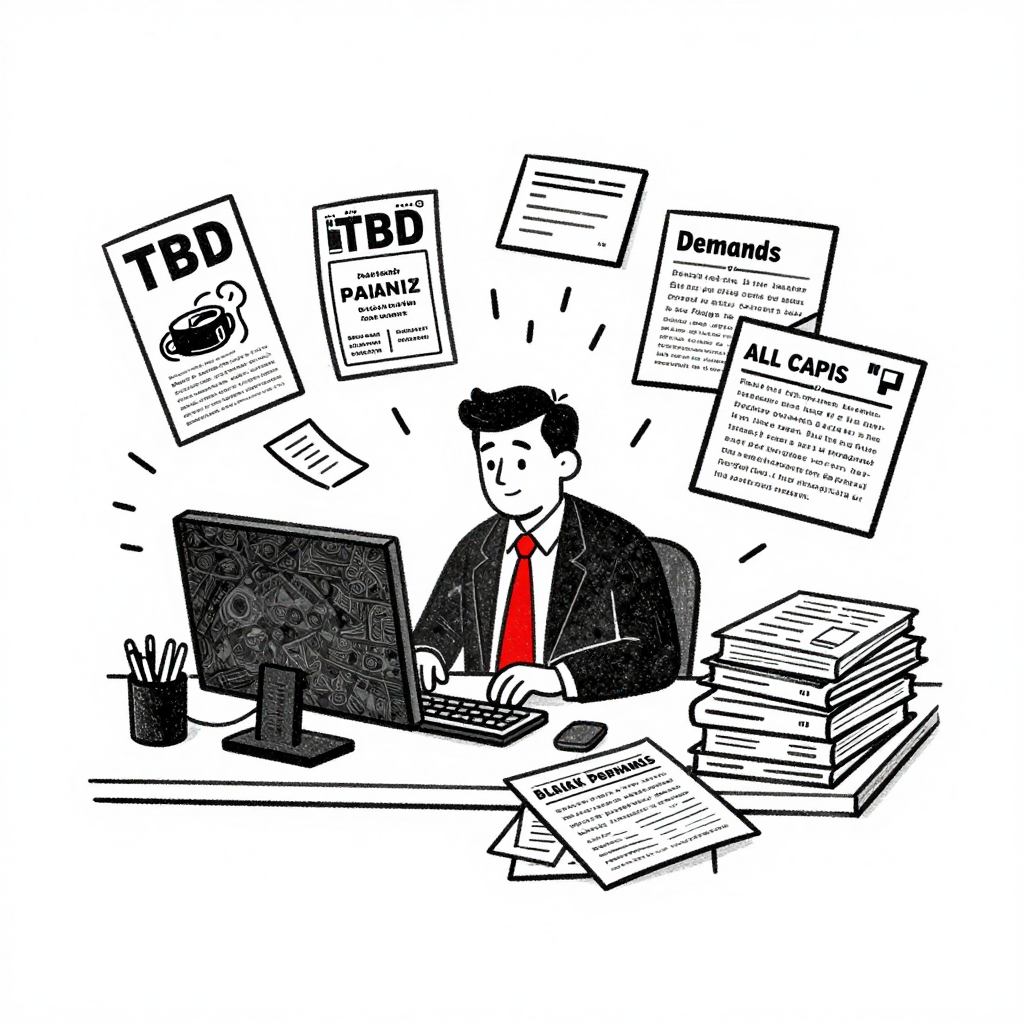
A day in the life of a Digital Marketer
A hilarious and painfully accurate satire of daily life in digital marketing. The narrator wakes up to discover a campaign spent its entire budget targeting Polish seniors interested in knitting. A client wants 'more reach' but has no goal, no strategy, and no product photos — but wants to be 'like Amazon.' Sales requests a brochure for a product that did not exist last week and has no copy, no images, and a name that is still 'TBD.' The CEO emails in ALL CAPS about $200 spent on traffic to the wrong website. The post resonated deeply because every scenario is something working marketers have actually experienced, often multiple times in the same week.
The brochure request for a product called 'TBD' is not satire. I have received that exact request at least three times.
— Party_Cheesecake_25416 pts
You forgot the part where the client sends you their competitor's website and says 'just do this but better' with no budget.
— DontHateThatPizza13 pts
The Polish seniors targeting is the kind of mistake you only make once. And then it haunts you forever in every campaign review.
— gamersecret212 pts
After 4 years in digital marketing, here are the hard truths nobody talks about at conferences
A four-year veteran shares mindset shifts that changed their career trajectory. The first truth: most published 'strategies' are disguised sales pitches missing critical context — the $30K ad budget, the 50K email list, the existing word-of-mouth traction. When you try to replicate those results with $500 and zero audience, it fails, and you blame yourself instead of the incomplete information. Second: SEO remains the most underrated long-term investment despite being unsexy. Third: the hardest skill in marketing is not creativity or data analysis — it is knowing when to stop a failing campaign instead of throwing more money at it hoping for a turnaround.
The missing context in case studies is the most important thing new marketers need to understand. Results without resources are meaningless.
— Radiant-Security-34761 pts
SEO is underrated because it takes 6-12 months to show results and most clients want ROI in 30 days. The ones who wait get rewarded.
— 3_Stax16 pts
Knowing when to kill a campaign is genuinely the hardest skill. Sunk cost fallacy destroys more marketing budgets than bad targeting.
— qaz135wsx16 pts
Most 'digital marketing gurus' are just selling courses, not results
A frustrated marketer observes that the industry has shifted from helping businesses grow to selling the idea of growth. The thread turns into a collective diagnosis of the 'guru economy' — where the most profitable marketing strategy is not doing marketing for clients but teaching others how to do marketing. Multiple commenters confirm the pattern: the gurus with the biggest followings often have no verifiable client results, only revenue from courses and coaching. The consensus solution is to evaluate any marketing educator by asking one question: can they show documented results for someone other than themselves?
The test is simple: if their only proven revenue source is selling courses about making money, they are not a marketing expert.
— FilmSkeez5 pts
The ones who are actually good at marketing are too busy doing client work to build a personal brand around teaching it.
— sriramkumar53 pts
This has been true since before the internet. The gold rush analogy holds: the people who got rich were selling shovels, not mining gold.
— vix_calls3 pts
Interesting View on Will: An Axiomatic Grounding of Agency Through Performative Necessity
A paper from PhilPapers proposes a novel approach to the problem of free will by grounding agency in 'performative necessity' — the idea that the act of deliberation itself presupposes a kind of freedom that cannot be coherently denied by the deliberating agent. Rather than arguing for or against libertarian free will or hard determinism, the paper attempts to establish axiomatic conditions under which agency becomes a necessary feature of any system capable of self-referential reasoning. The approach draws on speech act theory and formal logic to sidestep the traditional compatibilism-incompatibilism debate entirely.
Discussion thread for a recently published paper on the grounding of agency through performative necessity.
— AutoModerator1 pts
Freedom of Will: From Blind Drives to Novelty
A video essay exploring what remains of free will once we accept that consciousness does not originate action and the future is not fully determined. Rather than defending a traditional notion of free will, the piece asks whether there is a meaningful sense in which human agents introduce genuine novelty into the causal chain — not as uncaused causes, but as systems complex enough to generate unpredictable outputs from deterministic processes. The discussion draws on Schopenhauer's concept of the will as blind drive and contrasts it with emergence theories that locate freedom in the gap between stimulus and response.
The question is whether 'novelty' in a deterministic system constitutes genuine freedom or just the appearance of freedom from the inside.
— Schaapmail0 pts
OpenAI Smart Speaker
AI-powered home speaker with camera, facial recognition, and proactive suggestions
Nvidia Investing $30B in OpenAI
Largest private funding round in history reaches $100B+ at $830B valuation
David Silver's $1B Seed Round for Superintelligence Without LLMs
DeepMind veteran bets on reinforcement learning over language models
Fire Physics Was Broken. Not Anymore
A new research paper fixes longstanding problems with fire simulation in computer graphics. The previous approaches could not accurately capture the complex fluid dynamics, turbulence patterns, and light interactions that make real fire look convincing. The new method produces dramatically more realistic results.
Gemini 3.1 Pro and the Downfall of Benchmarks: Welcome to the Vibe Era of AI
A deep analysis of whether Gemini 3.1 Pro represents a new best model or the collapse of benchmarks as meaningful measures of AI capability. Covers a new Simple Bench record, hallucination caveats, the exponential improvement trajectory, and Dario Amodei's comments on generalization. Features analysis from seven papers arguing that we may need entirely new evaluation frameworks.